My father – a formerly robust man who lived hard, lived it up, never lived it down – lay dying. Having lost nearly half of his body mass, he appeared as a fragile skeleton, an image of weakness he would find appalling. The man who proudly served in WWII, who could fix anything, build anything, and who always saw the possibility of a better tomorrow, could no longer walk 15 feet to the bathroom without help. He could not sit without help. He could not stay awake for more than a few minutes at a time.
He asked me, “What are you trying to prove? You know, in your research?” I was in my fourth year of graduate school working on magnetic and electronic properties of intercalated titanium diselenides. They exhibited this very cool magnetic behavior mediated by conduction electrons but I didn’t really want to explain all this to him. So, I answered vaguely,
“Dad, I am looking at some compounds that have interesting magnetic properties.”
“What good is that?” he asked. He wasn’t the only one. “Why don’t you study cancer and help people like me?”
What could I say? That there were already people studying cancer? Lots of them? That my advisor inspired me and treated his graduate students like valued colleagues? That my research was exciting because I had the chance to understand, at the atomic level, how one particular aspect of the physical world works?
I punted. Notwithstanding the fact that studying cancer would require me to start grad school all over again, I just said, “I’ll think about it.”
“Good. I hope you can find a cure in time for me.”
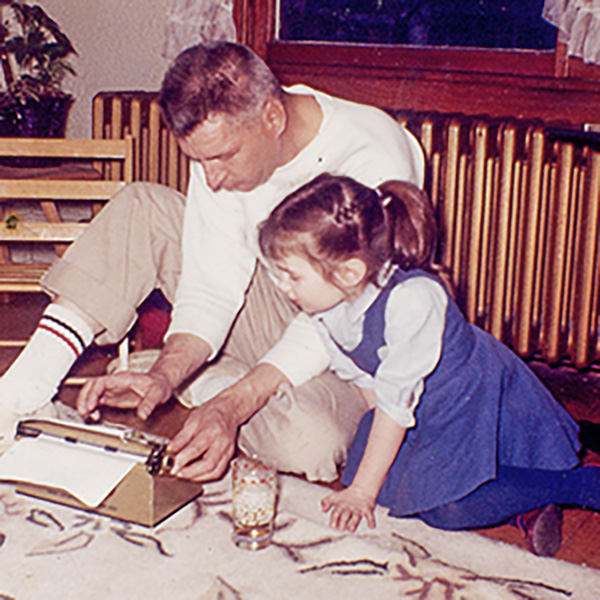
Dad always thought I could do anything. Even the impossible. As my number one fan, he thought I was charming and that my life was charmed. He once said, “Deborini, you could reach into a bucket of shit and pull out a gold watch. And it would still be running.”
And he was right, in a way. I certainly reached into my share of shit buckets and somehow things kept working out ok. Working out well. Great even.
But there was no finding a gold watch in the bucket of lung cancer that was destroying his 59 year-old body. Any watch in there was running down and there was nothing that my mom, my sister, my brother, or I could do. There was nothing the doctors could do.
Dad was not blessed with my apparent good luck. It seemed like he could reach into a bucket of gold watches and pull out a piece of shit. Nothing seemed to work in his favor. His life seemed plagued by disappointments and failures.
As Dad lay dying, it was easy to avoid those conversations that might have helped him make peace with his life. We lived a six hour drive away from my parents and only saw him on weekends. We were careful to keep our conversations light and easy. The weather. The news. The dinner menu. He’d complain that my mom didn’t chop the onions finely enough. That she was always putting that goddamned protein powder in his food and it tasted bad. That he was trying to get her to quit smoking because it could kill her too.
But nothing about his life. Nothing about his years in Europe during WWII where, as a 19 year old boy he was part of the military that was killing people who spoke his mother’s native language. Nothing about the anxiety and depression that led him to smoke 2 packs of cigarettes each day and drink himself into a stupor each night. Nothing about his dreams that never materialized. Nothing about the house he once lovingly built for his family, and subsequently lost in a foreclosure when finances, as always, went south. Nothing about his professional zenith and pride in being part of a team that launched the first upper atmosphere weather balloon, or the sting of being fired soon after the successful launch. Nothing about his shame and humiliation that he did not and could not reliably provide for his family. Nothing about those nights he avoided us by sitting in the car for hours and sneaking in when he thought we were all asleep.
Nor did I tell Dad about the day we bicycled to Crater Lake in Oregon and as we coasted for 100 miles down the mountain to the coast, I cried and cried because I wanted to show him the beauty in the world but knew he would never recover from the cancer that was ravaging his body. I did not tell him that my love for bicycling started with the used red two-wheeler that he cleaned up for me, adding training wheels so I wouldn’t fall. I never told him that when he wasn’t home, my brother secretly raised those training wheels so I could learn to balance then lowered them again to preserve Dad’s peace of mind.
I never told him how terrified I was when he left me alone in the car at night while he was inside a bar but how I loved that time he piled all the neighborhood kids into that same car and took us to Carvel’s for soft serve ice cream with peppermint dip.
I did not tell Dad how much he hurt us- the lies, the unkept promises, the yelling and the stealing. I didn’t tell him how scared I was on my tenth birthday when he lay in bed in the darkened bedroom and said he didn’t deserve to join us for my birthday dinner. I didn’t tell him how relieved I was when he finally came to the table.
I did not give him the chance to tell me that he didn’t mean to hurt us and that he was sorry.
Letters addressed to my mother, that I found long after his death and hers, revealed the depth of his shame, his pain and his regret.
I regret that we never talked about any of these things because the end came, and I lost forever the possibility of a conversation with my father.
* inspired by Grace Paley’s short story of the same name
Send comments
(include email if you want a response)


 My Cabinet of Curiosities