We landed in Beijing at about midnight local time and boarded a bus for the hotel. By the time we were checked into our rooms, it was probably 1:30 in the morning. My day started in Michigan nearly 30 hours earlier and although I had managed to sleep a few hours on the plane, I expected to crash for a good rest at the hotel. To my surprise and dismay, I woke up with the sun at about 5:30 am. This was in the summer of 2012, and was my first trip to China, indeed, my first trip outside of North America and Europe. To say I was excited would be like saying a habenero pepper is a little tangy. I wasn’t excited; I was bold-all-caps-large font EXITED! I tried to get more rest, but there was no more rest to be had; my brain was buzzing at the speed of light, my legs were twitching, so I just I got up and decided to go for a walk before breakfast.
I had absolutely no idea where our Beijing hotel was in relation to anything else. I had no map. I can read no Chinese. I knew I needed to be back at the hotel by 8:30 a.m. because my travel group would then board a bus bound for the Great Wall and would not be returning to this hotel. Ever. Missing the bus seemed ill-advised; getting lost seemed likely. But once outside, I realized that our hotel was on a main street and I figured that if I didn’t make any turns, I couldn’t go too far astray. I took a photograph of the front, just in case I needed help finding my way back.
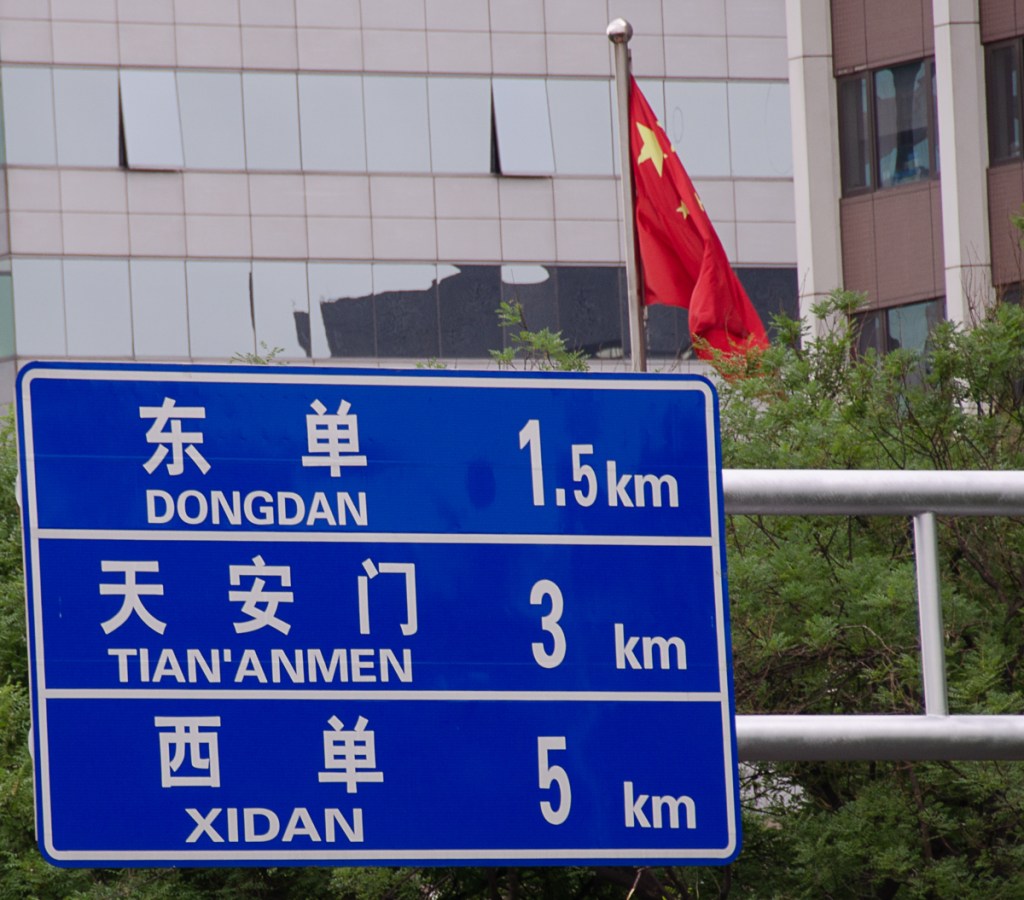
Soon, I came upon a bilingual sign pointing towards Tian’anmen Square, only 3 km away. That seemed like a good destination, so I watched for additional signs. I never saw another but after what seemed like 3 km,I saw a walled area across the street, which I guessed might be the place.
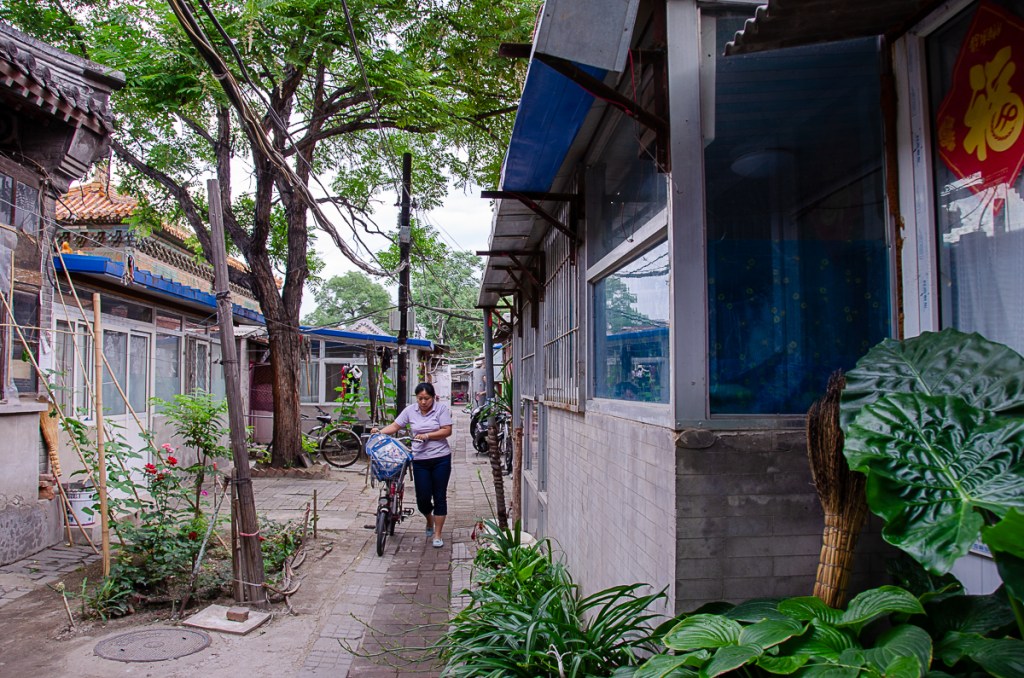
I crossed the street turned down a side street. Suddenly, I was in a different world.
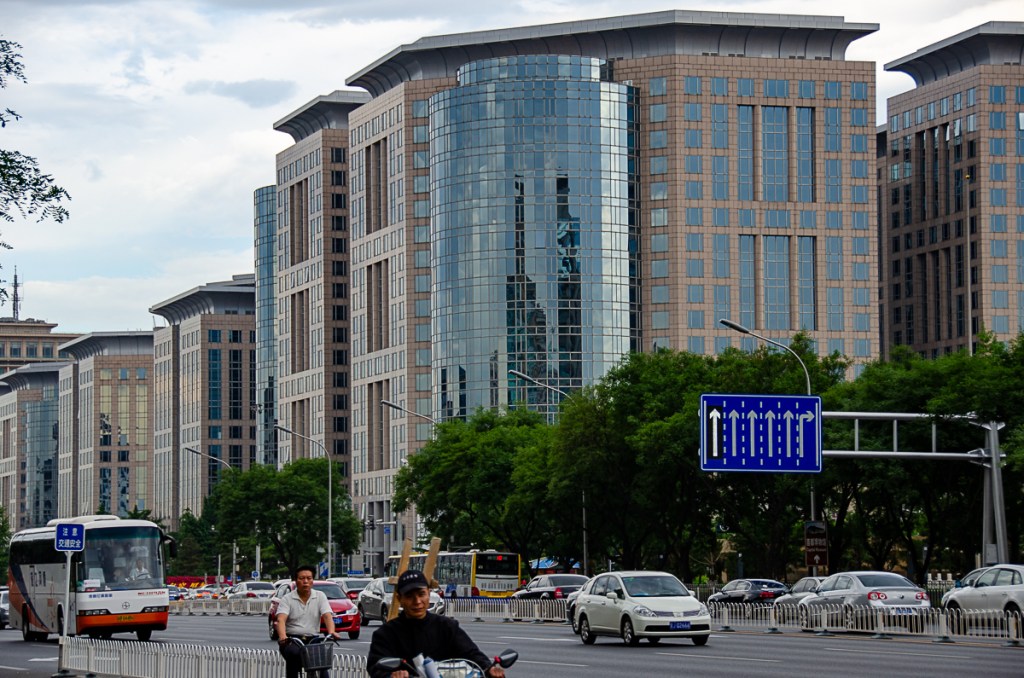
The very modern glass,brick, and steel buildings of the eight-lane main boulevard gave way to small shops, modest homes, and lush green spaces.
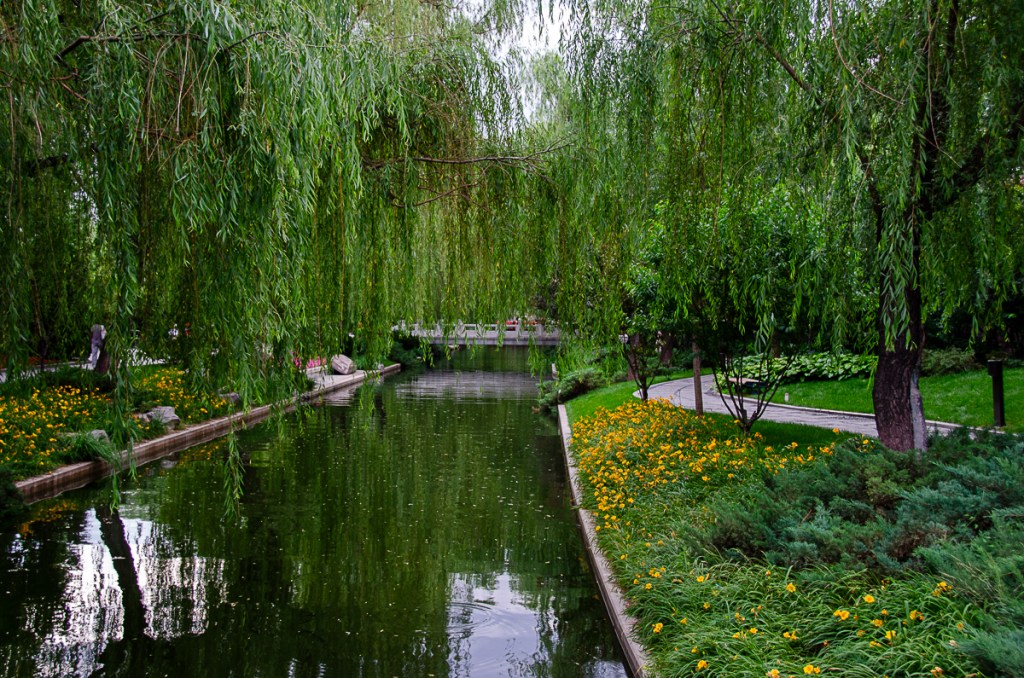
I figured the square had to be to my left so I looked for an entrance. I found a little gate and proceeded through. I was stopped by a young man who simply said, “Ticket.” He pointed to a makeshift kiosk so I went over and the woman there said “2 Yuan.” That was about 35 or 40 cents, so I assumed that I misheard. “2?” I asked? “2” she said holding up 2 fingers. So I paid the meager fee and went inside.
I found myself in a garden so quiet that I could hear my footsteps as I walked. I could hear the echos of the footsteps of the one other person in the garden, probably 100 feet away. Silence filled the air and every step, every breath seemed consequential.
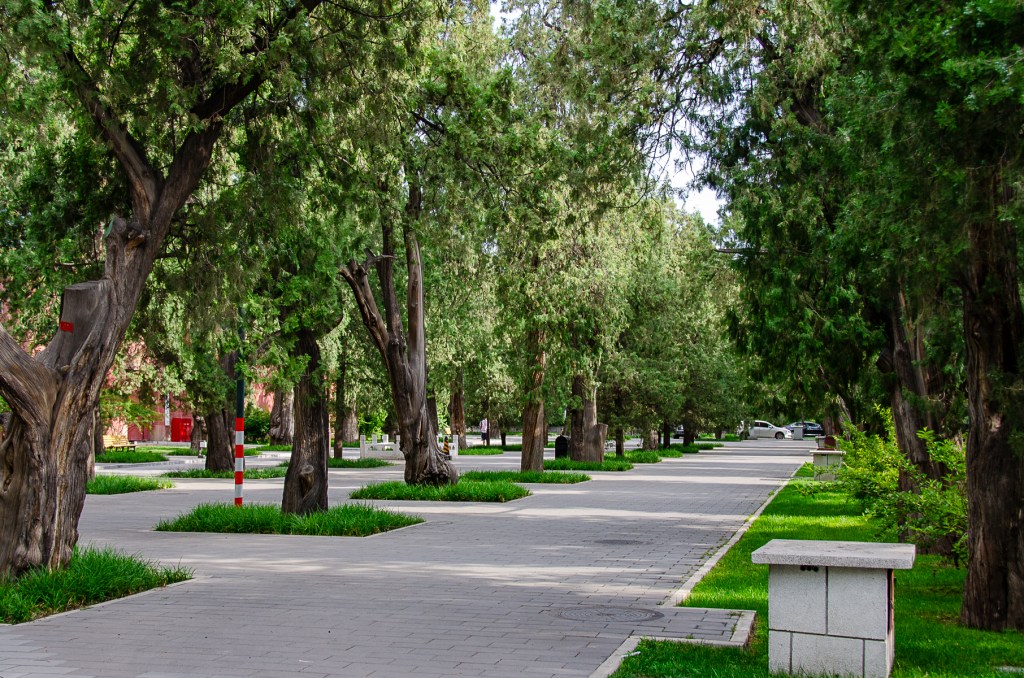
Stepping over a high threshold through an opening in the red wall, I found myself among yellow-roofed red temples, I did not know where I was, but the presence of the imperial colors suggested it was an important place.
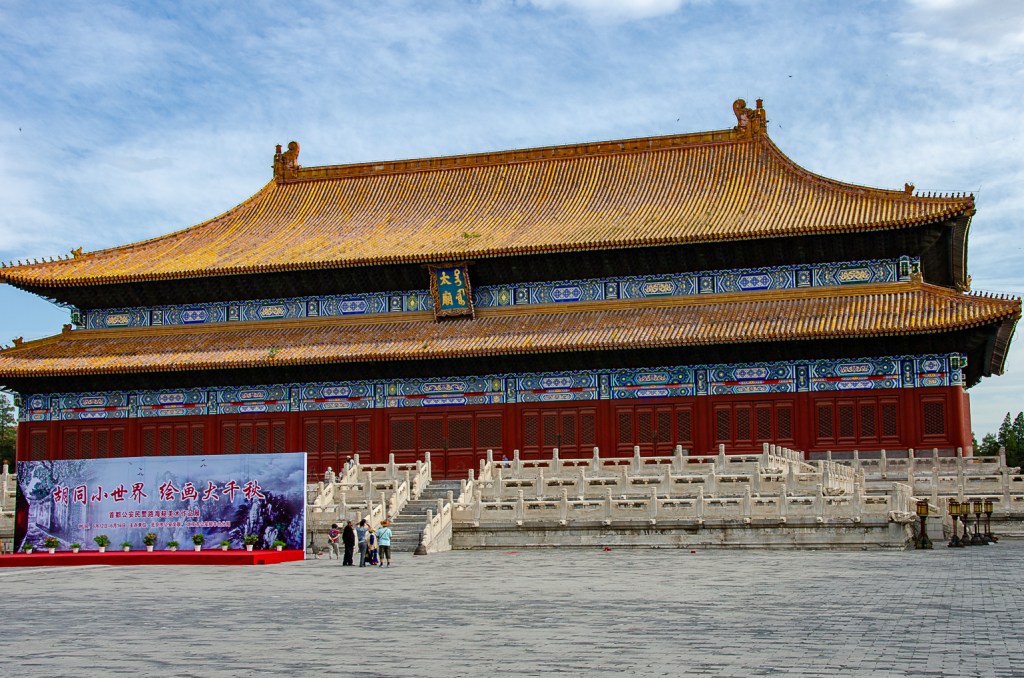
The largest structure was marked “Hall for Worship of Ancestors.” Completely by chance, I had stumbled into a public park called The Working People’s Cultural Palace that houses the Imperial Ancestral Temple and associated buildings. The Ancestral Temple is considered one of the most sacred buildings in Beijing and dates back to the 15th century. The whole area was part of the old imperial city and it turns out that I was very near the Forbidden City itself, and just a bit east of Tian’anmen Square. I couldn’t have entered either of those places, but I had the Imperial Ancestral Temple almost to myself in the quiet early morning hours.
Ancestors play a big part in Chinese culture, much larger than in our own. Our culture often treats the elderly as burdens to be borne and managed, not wise elders to be venerated. Still, Jonas Salk, pioneer of the polio vaccine, is quoted as saying “Our greatest responsibility is to be great ancestors.”
I often think about how much of my own ancestry is lost; we have some genealogies and the like, but know very little about our ancestors beyond the names and the dates. My parents told us stories of those characters, often disagreeing about details, while they sipped their after-dinner coffee and smoked cigarettes. I never really listened, usually opting for homework over reminiscing.
Now my parents’ generation, and much of my own, has passed and all those stories are lost. My husband Al and I liked to tell stories as well, but I assume that our kids were not really listening either. So, I am writing the family stories of our generation as well as what I can remember or piece together of previous generations, reflecting on important events and trips, collecting photos, preserving old-world recipes, and trying to capture our thoughts, beliefs, ideas, and opinions so that someday, when and if anyone wants to look back, they will be able to reconstruct our family in this time and in this place.
I don’t think it will make me a “great” ancestor, but it seems like the least I can do.
Oh. About that early morning walk in Beijing. I was so captivated by the buildings and gardens that I completely lost track of time. I suddenly realized I was going to be late unless I really hustled. So hustle I did, made no wrong turns, and arrived in time for breakfast as if I knew exactly what I was doing.
As if.
Send comments
(include email if you want a response)


 My Cabinet of Curiosities


