These days, neuroscientists use advanced imaging procedures like fMRI or PET scanning to map and correlate brain activity to various cognitive functions. So, I am sure my next observation would not stand up to the scrutiny of modern science, but intuitively I know this:
For a person whose primary language is English and who has only rudimentary knowledge of other languages, words are stored in our brains in one of two ‘bins.’ First, there is the large “ENGLISH bin” which holds thousands of words, sorted efficiently as to part of speech, tense, case and so on.
Then there is the much smaller “OTHER bin” where all other words are stored. The words in the “OTHER bin” are not sorted at all- certainly not by part of speech, certainly not based on tense or case. In fact, I have concluded that they are not even sorted by language.
They are all just tossed in that “OTHER bin” like the miscellaneous flotsam and jetsam that we hide in the junk drawer when company is coming.
The evidence for my hypothesis comes from my experiences abroad. I have been lucky to travel in to many countries in Asia, Europe, South American and Africa, where English is not the primary language. I think I know English pretty well, although some readers may disagree. Nonetheless, according to Wikipedia, a college educated person knows, on average, 17,000-word families, so I’ll assume I do too. I studied German in high school and college and remember a bit, but I’d optimistically estimate my German vocabulary to be less than 1% of my English vocabulary- maybe a hundred words at most. In my next best language, French, I may know a whopping total of 20-30 words, excluding menu items. In Spanish, I learned maybe 5-10 non-culinary words – certainly not enough to express a single thought or idea. Considering Chinese (3-4 words) and Arabic (1 or 2 words) and you can see why I am grateful that people all over the world place a high value on studying the English language.
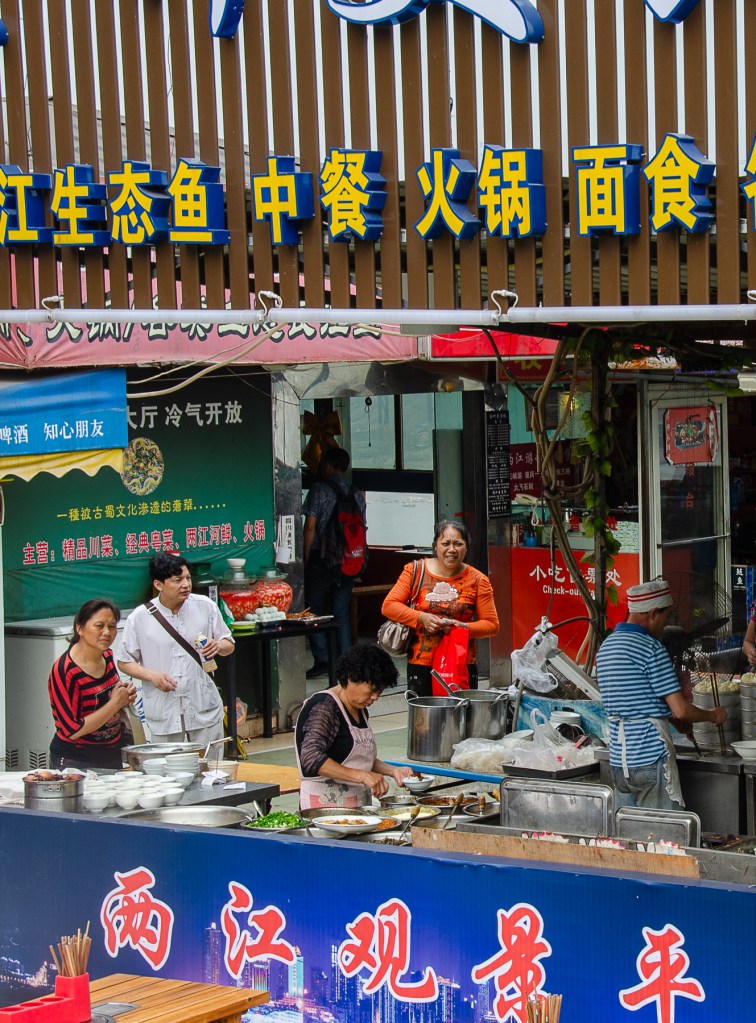
No matter where we were, we could usually find someone who could speak at least some English and could help us out. In Asia, we had full-fledged translators, which was helpful, because otherwise I would never have said more than 你 好’ [nǐ hǎo] and 謝 謝 [xie xie]. Actually, “Hello” and “thank you” can take you surprisingly far in a foreign land, but are not exactly enough for deep conversation, or any conversation for that matter.
So, my “English word bin” contains 17,000-word families, and all together my “OTHER bin” includes at most a couple hundred words, tossed together randomly, a veritable smorgasbord of gibberish. I have a strong conviction that when traveling it is polite to be able to at least say SOMETHING in the native language of the country I’m visiting, but when I reach into my “OTHER bin” for a word or a phrase that I tried to learn, pretty much anything could come out. It is like reaching blindfolded into the junk drawer for a screwdriver and getting a roll of scotch tape. So, I have found myself thanking Moroccans in Spanish, greeting Chinese people in German, ordering water in Japan using French, and looking for the toilette in languages that neither I nor my listener knew at all, indeed, sometimes in languages that were fictitious hybrids of miscellaneous sounds and syllables cobbled together.
Our daughter, Ellen, fluent in both Japanese and Korean, calls it linguistic confusion.
I call it embarrassing.
Embarrassed or not, I will continue my inadequate attempts at communicating in the language of the nations I visit as we continue our global journeys. Throughout our travels, we have always been received with warmth and tremendous hospitality. For that, I say Danke sehr, merci, gracias, grazie,Σας ευχαριστώ , obrigado, děkuju, ありがとう ,谢谢 , شكرًا
Send comments
(include email if you want a response)


 My Cabinet of Curiosities