How would you find this sum?
12+47+18=
It turns out that the way you do this simple sum may predict your success in solving more advanced problems.
A recent column in Scientific American (April 2026, pg. 20) described research that asked 213 high school students to perform addition problems like the one above.
The researchers identified two strategies. One group of students dutifully lined up the numbers as we were all taught in elementary school like this:
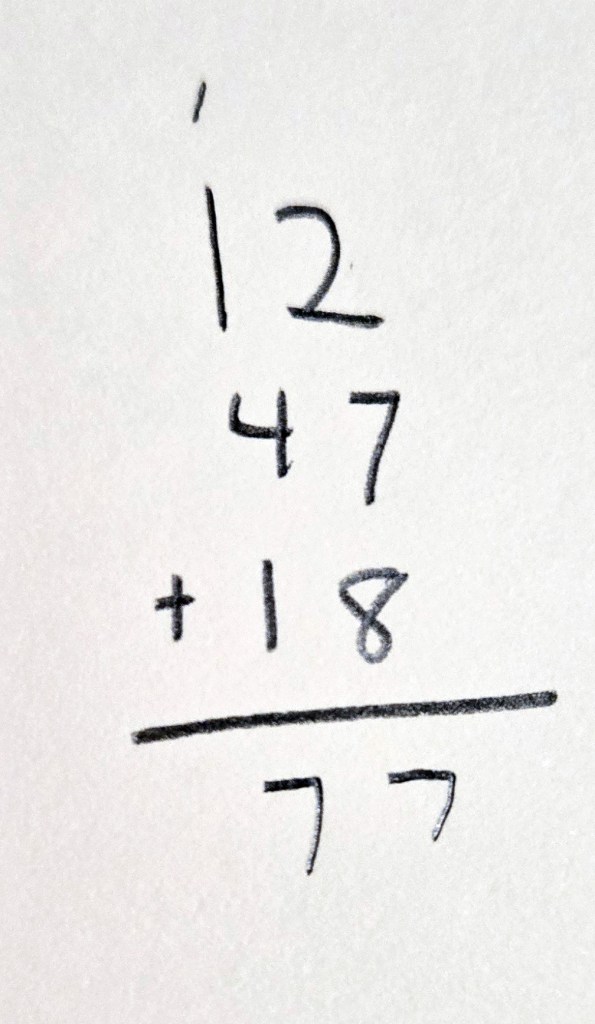
then added the ones column, 2+7+8 to get 17, carried the one to the tens column and then added the tens column 1+1+4+1 to get 7. Answer is 77.
The other group reformulated the question. Recognizing that 12+18 is equal 10+20, they changed the problem to 30+47 which is much quicker.
The interesting thing about this study was that 52% of girls used the formal procedural method, while 72% boys reformulated the question.
A second independent study found similar results for adult women.
Subsequent research showed that “students who reported a greater desire to please their teachers, a trait that skews heavily female, tended to use the procedural method.” This might not seem important, but students who used the procedural method (i.e. girls) exactly as they were taught, were less likely to solve new problems that were different from ones they had seen before.
The researchers concluded that the girls desire to do things “right” may hold them back in more advanced study and that differences in performance may not be due to “ability but rather the intersection of instruction, classroom norms, anxiety, and what students believe is expected of them.”
Interesting. Whatever the origins of math anxiety in girls, it is alive and well. In 2005, Larry Summers, then President of Harvard University, famously said that women may be under-represented in math and science due to “innate” differences in “intrinsic aptitude.” Don’t get me started on that one.
I am a woman. I am a scientist. I was a researcher and taught university level physical chemistry. I can do math.
As you would expect, I believed that it was important for my own children to have a solid foundation in science and math as well.
And they did. However, there were complications in building that foundation for our daughter, Ellen.
In 1992, when Ellen was a year old, Mattel introduced “Teen Talk Barbie.” A push of a button and Barbie would say things like “Math class is tough.” Another push of the button and she said “Let’s go shopping” This scientist mom was apoplectic at these overtly sexist, anti-math messages, and I tried everything in my power to dissuade my young daughter from playing with Barbies. When she was little, I said “ Oh yuck! Barbie!” whenever I saw any kind of Barbie advertisement. Of course, my efforts had no impact whatsoever and we still have a large box of Barbies and associated paraphernalia in our basement that now-34 year old Ellen needs to deal with.
In truth, “Teen Talk Barbie” was taken off the market fairly quickly and we never had one. Nonetheless, our daughter clearly picked up on the “Math is hard” culture and was utterly convinced that she was bad at math.
She isn’t. At all. However, her belief was persistent and we had to ban the sentence “I’m bad at math” as we banned other profanity in our home. It was replaced with “Can you help me with my homework?”
For Ellen, the negative attitudes became apparent in elementary school when she was required to learn the multiplication tables. She resisted tooth and nail. Looking back, I think the problem was that the kids were given frequent tests called “mad minutes” and they were graded on how many multiplication problems they could do correctly in one minute. Ellen was meticulous and careful. She got them right, but didn’t complete as many as some of the other kids. Therefore, she came to truly believe that she was bad at math and put up defensive barriers to avoid doing it.
But since I’m her mother, learning basic multiplication was not optional. I randomly quizzed her to her exasperation. For example, in the car on our way to the grocery store, I might ask, “Ellen, what is 8×6?”
She’d fuss at me and say,”Mom! This isn’t homework time.”
And I’d say, “I know. So, what is 8×6?” Eventually, she’d answer.
Or at dinner, “Ellen, what is 7×4?”
She looked at me with fire in her eyes, “I’m eating, ok?”
“Sure. So what is 7×4?”
With a huff, she’d concede. “28. Ok? Can I eat now?”
We read to our kids at bedtime long after they could read on their own.. Story time was sacred in our home. One night at bedtime, she was settled in for a chapter of Roald Dahl’s “James and the Giant Peach.” As I opened the book, I asked, “What is 9×12?”
She glared at me and shouted, “Mom! It’s story time, not math time.”
I replied “I know, so what is 9×12?”
Digging in her heels she retorted “Mom! How am I supposed to know that?”
I waited. In just a few seconds, she exhaled dramatically and said “Ok, it’s… 90+18… 108 .. ok?”
“Yes,” I said. “But don’t ever tell me you aren’t good at math—you just intuited the distributive property of multiplication.”
“I did what?”
“Never mind” I said, “it’s story time… Where were we. Oh yes, Chapter 3”
Ellen ultimately overcame her aversion to math and science and is now a technical translator, translating patents from Japanese to English.
For many kids, and especially girls, math remains a barrier. Unnecessarily. The research highlighted in Scientific American may provide important insights to eliminating those barriers.
Send comments
(include email if you want a response)


